
Construction & Demolition Waste Recycling
Concrete, bricks, cement, sand, tiles, doors, windows, and roofing material.
Compliance
CPCB Authorized
Audit Trail
Official Certificate
Experience
25+ Yrs Leadership
Certified Construction & Demolition Waste Recycling
Full chain-of-custody collection, authorized processing, and CPCB green audit clearance across NCR.
Understanding Construction & Demolition Waste Recycling in India
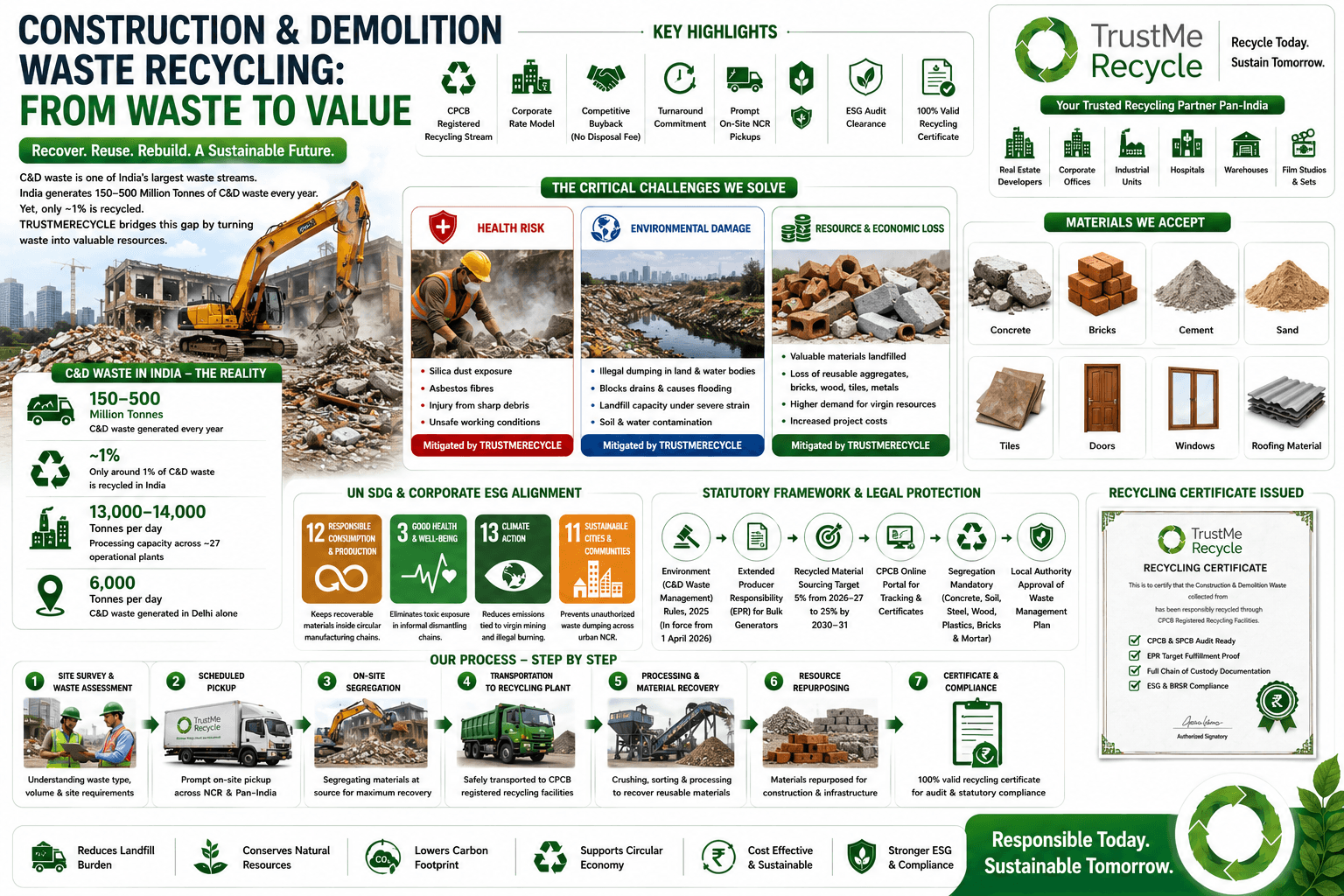
Construction and demolition (C&D) is one of India's largest — and least tracked — waste streams. Estimates from the Ministry of Housing and Urban Affairs and the Central Pollution Control Board put national C&D waste generation anywhere between 150 million and 500 million tonnes a year, a wide range that itself points to how poorly this stream has historically been measured (CSE, 2023). Of what is generated, independent research by the Centre for Science and Environment (CSE) found that India recycles only around 1% of its construction and demolition waste, against a national processing capacity of roughly 13,000–14,000 tonnes per day across about 27 operational plants (CSE study, December 2023). Delhi alone generates an estimated 6,000 tonnes of C&D waste every day.
Every demolished bungalow, redeveloped office floor, decommissioned warehouse, or dismantled film studio set adds to this pile — and most of what comes out of it is not waste at all. Concrete, bricks, cement, sand, tiles, doors, windows, and roofing material are recoverable materials with real resale value, if someone collects, sorts, and channels them correctly. That is the gap TRUSTMERECYCLE operates in for clients pan-India.
Key Highlights
Processing Model
CPCB Registered Recycling Stream
Corporate Rate Model
Competitive Buyback (No Disposal Fee)
Turnaround Commitment
Prompt On-Site NCR Pickups
ESG Audit Clearance
100% Valid Recycling Certificate
Materials We Accept
The specific construction & demolition waste sub-types TRUSTMERECYCLE buys, collects, and routes to compliant recycling.
The Critical Challenges We Solve
Unregulated waste disposal creates severe health risks, environmental damage, and financial losses.
Health Risk
Uncontrolled demolition sites expose workers and nearby residents to crystalline silica dust, asbestos fibres (common in structures built before the 2000s), and physical injury from unsegregated debris — exposed rebar, broken glass, and unstable panels.
Environmental Damage
A large share of India's C&D waste is dumped illegally on vacant land, in water bodies, or along roadsides rather than processed, consuming landfill capacity that is already under strain and degrading local drainage and water quality.
Resource & Economic Loss
With recycling rates near 1%, genuinely reusable material — concrete aggregate, bricks, seasoned wood, tiles, doors, and windows — is buried or discarded instead of re-entering the supply chain, forcing continued extraction of virgin sand, aggregate, and timber.
Health Risk Breakdown
Demolition and renovation work generates fine particulate and crystalline silica dust linked to respiratory illness with prolonged exposure. Older structures may contain asbestos-based roofing, insulation, or pipe lagging, which becomes hazardous only when disturbed — exactly what happens during uncontrolled demolition. Unsegregated debris piles with exposed rebar, glass, and sharp fittings are also a direct injury risk to site workers and anyone passing through informal dump sites.
Environmental Impact
Illegally dumped C&D debris clogs drains and chokes water bodies across NCR, worsening urban flooding during monsoon. Every tonne of C&D waste that is landfilled instead of processed is also a tonne of virgin sand, aggregate, or timber extracted afresh — extraction that carries its own environmental cost, from riverbed sand mining to deforestation for timber. Recovering and reusing concrete, bricks, and wood in particular avoids a meaningful share of the embodied carbon involved in producing new material.
UN SDG & Corporate ESG Alignment
Partnering with TRUSTMERECYCLE provides auditable proof for corporate BRSR disclosures and international sustainability standards.
Responsible C&D waste management supports SDG 11 (Sustainable Cities and Communities), SDG 12 (Responsible Consumption and Production), and SDG 9 (Industry, Innovation and Infrastructure) by keeping recoverable material in circulation and reducing landfill and virgin-resource dependence. For corporate and institutional clients, diverting demolition and renovation waste from landfill is an increasingly visible line item in ESG and Business Responsibility and Sustainability Reporting (BRSR) disclosures.
Responsible Production
Keeps recoverable materials inside circular manufacturing chains.
Good Health & Well-being
Eliminates toxic exposure in informal dismantling chains.
Climate Action
Reduces emissions tied to virgin mining and illegal burning.
Sustainable Cities
Prevents unauthorized waste dumping across urban NCR.
Regulatory Rules & Legal Protection
C&D waste in India is governed by the Environment (Construction and Demolition) Waste Management Rules, 2025, in force from 1 April 2026, replacing the earlier Construction and Demolition Waste Management Rules, 2016 and expanding from 10 to 21 provisions. Key features include Extended Producer Responsibility (EPR) obligations for bulk generators (projects with a built-up area of 20,000 square metres or more), phased recycled-material sourcing targets starting at 5% from 2026–27 and rising to 25% by 2030–31, and a CPCB-run online portal for tracking waste utilisation and issuing certificates.
The underlying 2016 framework already required waste generators producing more than 300 tonnes per project per month to segregate waste into concrete, soil, steel, wood and plastics, and bricks and mortar streams and submit a waste management plan for local authority approval.
Recycling Certificate Issued
Every consignment concludes with an official document suitable for corporate audits, EPR compliance, and government inspections.
How TRUSTMERECYCLE Handles Construction & Demolition Waste
A transparent 6-step recycling lifecycle built for scale, accountability, and regulatory clearance.
Site Assessment & Quote
We visit the site and quote competitive buy-back rates for recoverable material: concrete, bricks, tiles, doors, windows, and roofing material.
Frequently Asked Questions
Ready to Clear Out Your Construction & Demolition Waste?
Schedule a free on-site evaluation in Gurugram & NCR. Get fair competitive market pricing, prompt pickup, and official CPCB compliance certificates.